When we talk about landing airbags, we often focus on the features athletes and operators can see: impact absorption, adjustable firmness, realistic landings, and durability. But there is another important part of the technology that is less visible: the material itself. So, what are landing airbags made of, and why does the choice between polypropylene and PVC matter?

PP vs PVC airbag material: why does the difference matter?
For many years, PVC has been a widely used material for inflatable products, including landing airbags. Its established manufacturing processes and useful mechanical properties have made it a practical choice for demanding applications.
However, when we assess an airbag across its entire lifecycle, material selection becomes more important. The PP vs PVC airbag material question is therefore not simply about which fabric is stronger or lighter. We also need to consider transport, handling, durability, repair, end-of-life processing, and the possibility of recycling.
Our current circular design strategy moves towards PP-based construction because polypropylene offers a combination of mechanical performance and recyclability that supports these objectives. According to our material research, PP provides higher tensile strength and up to three times greater tear resistance than PVC. At the same time, it can create a lighter overall construction. That makes the material transition relevant not only from an environmental perspective but also from an operational one.
What are landing airbags made of?
Why we are moving towards a polypropylene airbag
Is polypropylene recyclable?
Yes, polypropylene is widely recyclable and compatible with existing recycling systems. This is one of the key reasons we selected PP as the direction for our next generation of airbags.
However, is polypropylene recyclable in an airbag in exactly the same way as a simple PP consumer product? Not necessarily. The complete airbag system contains multiple components, and not every part is currently recyclable. Our objective is therefore to reduce material complexity and make the main material easier to recover, rather than suggesting that every component can already enter a closed-loop recycling process.
Our planned circularity model addresses this directly. When an airbag reaches the end of its usable life, we aim to take it back and send recoverable PP material to specialised recycling partners. Depending on the material and available processing route, it can be converted into recycled pellets or downcycled into other products. Remaining non-recyclable components are handled separately as residual waste.
There is also a financial dimension that is easy to overlook. PVC typically costs money to dispose of at the end of its life: labour is required to handle the material, and collection and disposal fees have to be paid on top of that. With PP, the position is different. Recycling facilities may collect the material free of charge and, in some cases, pay for it, depending on the amount and quality of the PP being recycled. The value varies by country and local recycling market, but because PP can hold value as a recyclable material, there is potential to recover some money at the end of the product’s life rather than paying for its disposal.
PP vs PVC: more than an environmental comparison
The discussion around PP vs PVC material should not be reduced to “new versus old” or “sustainable versus unsustainable.” Both materials have different technical characteristics, and an airbag manufacturer has to consider safety and performance before anything else. For us, the important question is whether a new material can meet (or exceed) the requirements of professional landing equipment while also creating better opportunities for responsible product management.
Our current findings are encouraging. The PP material direction offers higher tensile strength, up to three times greater tear resistance, lower weight, better recyclability, and, in many markets, a lower end-of-life cost. We are also continuing to validate performance through real-world testing and further research.
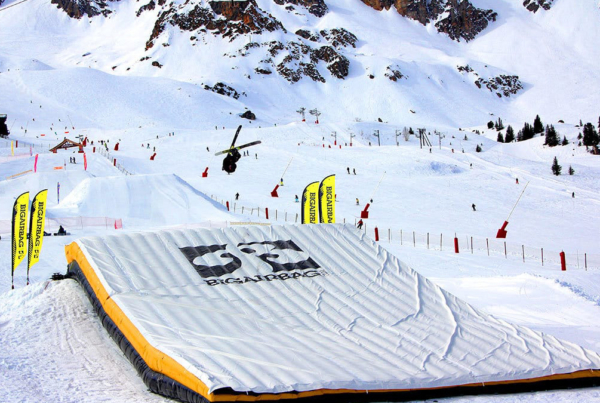
This is particularly important because landing airbags are not lightweight consumer products. They are safety-critical systems designed for repeated use in environments ranging from BMX and FMX facilities to ski resorts, gymnastics centres, and adventure parks.
Does a PVC-free airbag perform differently?
The transition towards a PVC-free airbag is not intended to change the way customers use our systems. Installation, setup, and operation remain essentially the same, while the lower weight of PP-based construction can make handling easier. We continue to design our systems around the features that athletes and operators already rely on, including adjustable impact characteristics, durable construction, and professional installation and support.
For example, our landing systems can use independently adjustable impact zones, allowing operators to modify firmness according to the activity and progression level. Our Ride-Away Topsheet technology is also designed to combine strength, durability, flexibility, and elasticity to support realistic landings. In other words, changing the base material does not mean abandoning the technology and design principles that make a landing airbag effective.
Designing airbags for longer lifecycles
Material choice is only one part of a more sustainable product strategy. We also need to think about how long an airbag remains in service.
This is why we place considerable emphasis on maintenance and repair. Our circularity model prioritises servicing and repairing airbags wherever possible, helping keep products in use for longer and avoiding unnecessary replacement. Depending on application, wear, and maintenance, our current circularity model anticipates a use phase of up to 10 years.
This approach changes the question from “What happens when the airbag is no longer useful?” to “How can we keep its materials and components useful for as long as possible?”
The future of airbag materials
The move from PVC towards PP is an important step, but we see it as part of an ongoing process rather than a finished solution.
We are continuing to investigate the full environmental footprint of our products through lifecycle assessment, improve blower efficiency, and research recyclable topsheet materials. We are also working towards a model in which more of the materials used in our products can remain in circulation after their initial service life.
Ultimately, the PP vs PVC material discussion is about more than choosing one fabric over another. It is about reconsidering how landing airbags are designed, manufactured, used, maintained, and recovered.
For us, the goal is straightforward: progression without compromise. We want our airbags to remain safe, durable, and high-performing while becoming lighter, stronger, and better prepared for a more circular future.