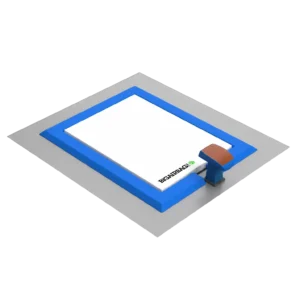
When we think about innovation in action sports, we often think about bigger jumps, new tricks and safer ways to progress. At BigAirBag, however, we believe that progression should extend beyond performance. The way we manufacture our products, the materials we use and what happens to an airbag at the end of its useful life all form part of the bigger picture. That is why we are taking a closer look at our carbon footprint and developing a new approach to the way we design and manufacture landing systems.

Why carbon footprint matters for airbag manufacturing
A landing airbag is a specialised piece of sports equipment. It needs to withstand repeated impacts, intensive use, transportation and different operating environments while maintaining predictable performance. For that reason, choosing materials cannot be based on a single factor.
When we assess our carbon footprint, we look beyond the moment a product is being used. Manufacturing, raw material production, transport, maintenance and end-of-life processing can all contribute to a product’s overall environmental impact. Our Circularity Initiative is therefore built around considering the entire product lifecycle rather than focusing exclusively on individual manufacturing stages.
This lifecycle perspective is particularly relevant when developing low carbon footprint sports equipment. A product that lasts longer, weighs less and offers improved possibilities for material recovery can reduce the resources associated with replacement and disposal over time.
From PVC towards PP
For many years, PVC-based materials have played an important role in inflatable equipment. We have used them in our airbags because they provide the durability and technical characteristics required for demanding applications.
However, our research has shown that polypropylene offers several advantages that make it an interesting material for the next generation of our products. PP provides higher tensile strength and up to three times greater tear resistance than the PVC materials we previously used. It is also lighter, which can make airbags easier to transport, install and handle.
This is an important part of our approach to reducing our carbon footprint. Material selection affects more than the production stage: a lighter product can also require fewer resources to move and handle throughout its lifecycle. At the same time, we are not treating PP as a simple replacement material. We are using the transition as an opportunity to rethink the complete design of our products.
What does PP mean for our airbag carbon footprint?
One of the key questions is how changing from PVC to PP affects the airbag carbon footprint. At the material production stage, PP is estimated to have a nearly 60% lower CO₂ footprint than PVC. Beyond material production, we are also looking at the wider lifecycle of our airbags, including manufacturing, transport and end-of-life processing, to better understand the overall impact of the transition from PVC to PP.
These figures and calculations are important indicators, but they should also be understood in context. They help us identify where improvements can be made, rather than suggesting that every BigAirBag product automatically has the same footprint. We are continuing to develop our approach and validate the data behind it.
For us, measuring carbon footprint is therefore not about arriving at one final number and stopping there. It is about building a clearer picture of our impact, identifying where improvements are possible, and using better data to guide future decisions.
Building low carbon footprint sports equipment
Reducing environmental impact cannot depend on material choice alone. Product longevity is equally important.
A durable airbag that can remain in service for many years may reduce the need for replacement and therefore avoid the material and manufacturing impacts associated with producing a new product. Our new PP material has been tested in real training environments, including high-throughput applications, where it showed less wear than a PVC airbag in the same environment.
We also believe that repair should come before replacement wherever possible. Maintenance and repair can extend the useful life of an airbag, while our circularity model is being developed to include a take-back pathway when products eventually reach the end of their operational life. Depending on application, wear and maintenance, our current model anticipates a use phase of up to 10 years.
What does CO₂ emissions mean for our approach?
The discussion around CO₂ emissions can become complicated quickly, especially when products have long lifecycles and multiple components. Rather than treating sustainability as a single metric, we prefer to look at the different stages that contribute to our products’ overall impact.
Our approach can be understood through three connected areas: materials, product lifetime and end-of-life recovery. The first concerns the emissions associated with producing the materials we use. The second considers how long those materials remain useful in a working product. Lastly, the third asks what can happen to them after the airbag is no longer suitable for continued use.
This broader perspective is particularly important when discussing initiatives and other approaches to understanding or communicating carbon impact. We focus on measurable changes within our own products and manufacturing process rather than making broad environmental claims that cannot be supported by our available data.
Sustainably manufactured freestyle equipment
Freestyle sports place demanding requirements on equipment. Skiers, snowboarders, BMX riders and other athletes need landing systems capable of absorbing repeated impacts while maintaining reliable performance. Our work on sustainably manufactured freestyle equipment therefore starts with the same principle that has guided our product development from the beginning: sustainability cannot come at the expense of safety.
As we introduce more circular materials into our products, we continue to apply the same performance requirements. The objective is not to create a separate category of “green” equipment, but to make our existing high-performance systems more responsible throughout their lifecycle.
Designing for circularity, not just recycling
Recycling is an important part of our strategy, but it is only one stage of circular design. Our PP-based direction is intended to simplify the main material system and make it better suited to recycling, reuse or downcycling. PP is widely recyclable and compatible with existing recycling systems. At the same time, we recognise that an airbag is a complex product and that not every component can currently be recycled.
That is why our circularity model prioritises several steps: sourcing PP-based material, manufacturing durable airbags, keeping products in use for as long as possible, repairing them when needed, and eventually recovering the material through a planned take-back pathway.
We are also researching recyclable topsheet materials and improvements to blower efficiency. These projects demonstrate why we see circularity as an ongoing process rather than a single product update.
Progression without compromise
For us, reducing our carbon footprint is part of a much broader idea of progression. We have spent years helping athletes, operators and attractions push their limits. Now, we want to apply that same mindset to the products themselves.
We know there is still work to do. Measuring the full carbon footprint of an airbag system, improving component recyclability and reducing energy use are ongoing challenges. Our Circularity Initiative is designed to address these challenges step by step.
Ultimately, we believe the future of sports equipment should not be defined only by how well it performs on the day it is installed. It should also be measured by how long it lasts, how efficiently it can be maintained, what materials go into it and what happens when its first life comes to an end. That is the direction we are taking at BigAirBag: progression without compromise, for a future worth landing in.